
The Human Visual Cortex#
Further Reading
This page introduces the visual cortex at a high level but is not intended to be a thorough treatment of the subject. For a more detailed treatment, we recommend this online course on the Human Brain by Prof. Nancy Kanwisher (Massachusetts Institute of Technology), in particular episode 3.8 (Beyond V1: Lots of Visual Areas). Episodes 2.11 (fMRI), 3.4 (LGN & V1), and 3.5 (Retinotopic Maps), are also excellent lectures about the topics of the previous chapters in this section.
The human visual cortex is tiled by numerous distinct functional visual areas, most of which contain some kind of retinotopic map of the visual field. Example of segmentations of the visual cortex into distinct functional regions were previously shown in Figures 4 and 6. Each of the visual areas shown in these figures contain retinotopic maps—the left hemisphere (LH) and right hemisphere (RH) parts of a functional region together represent the entire visual field; the LH contains the right visual field representation and the RH contains the left.
Visual maps that share a boundary, such as V1 and V2 (Fig. 4), typically share the representation along the boundary, as if one area’s retinotopic representation were mirror-reversed onto the cortical surface of the other area immediately across the boundary. These mirror-reversal are readily apparent if we examine the boundaries of areas while visualizing the pRF centers of each point on cortex. Figure 8) shows visual area boundaries drawn on top of the pRF centers, as visualized using polar angle and eccentricity maps. Notice that in the top two hemispheres (the polar angle maps) most of the boundaries occur along a reversal of the colormap.
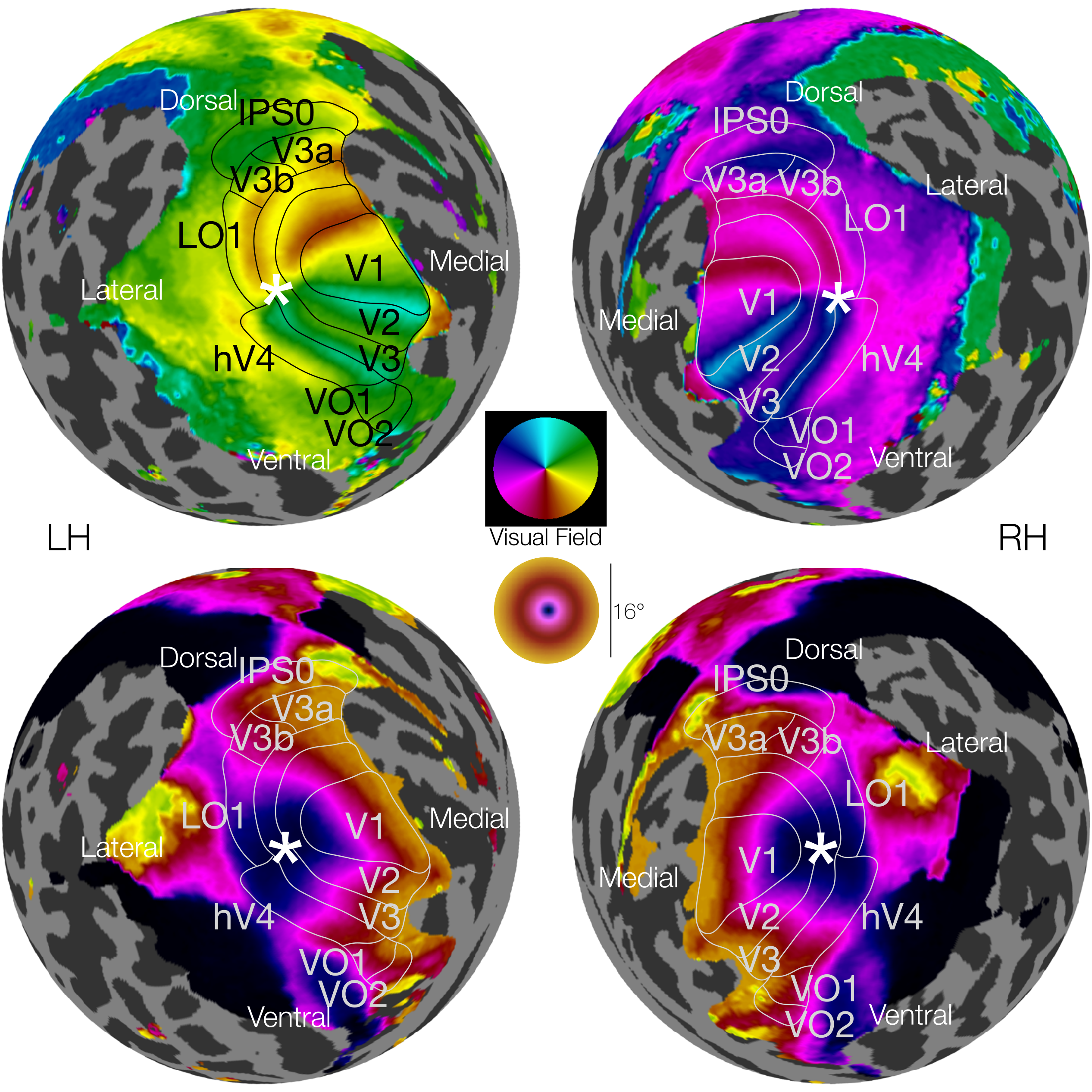
Figure 8. Polar angle (top) and eccentricity (bottom) maps of many visual areas in the posterior visual cortex. The flatmaps pictured here were created using the same projections as in Figure 4. The large star in the center of the maps shows the approximate position of the occipital pole (the most posterior/rear point on cortex) while left and right are preserved.#
The many functional visual areas of the human visual cortex perform many functions and often grouped on cortex according to their function. In this project, we will focus on a few specific groups of visual areas: occipital cortex, which is further divided into medial, dorsal, and ventral sections, and ventral occipital temporal cortex (VOTC).
Are “visual cortex” and “occipital cortex” different?
“Occipital cortex” and “visual cortex” are often used interchangeably. Technically, the occipital lobe is an anatomical region at the back of the brain, and the “occipital cortex” is the part of the cerebral cortex in the occipital lobe. The “visual cortex”, on the other hand, refers to the part of the cortex that performs visual functions, which mostly overlaps with the occipital cortex. However, the “occipital cortex” is an anatomical definition that depends on the brain’s shape while the “visual cortex” is a functional definition that depends on the brain’s function.
Occipital Cortex#
Occipital cortex includes V1 (primary visual cortex) and the visual areas immediately surrounding it, stretching up through dorsal regions, down through ventral regions, and around through lateral regions.
Medial Occipital Cortex#
V1, the first cortical stop for visual information arriving from the eyes, lies along the medial surface of the occipital cortex. Surrounding it on all but its anterior side lies V2, which is similarly surrounded by V3. Although V1 contains a complete uninterrupted representation of half of the visual field, V2 and V3 are split along the horizontal meridian into dorsal an ventral halves, each of which represents a quarter of the visual field.
V1, V2, and V3 are the earliest stops for information on cortex, and, for this reason, they are sometimes called the “early visual cortex”. They are thought to process very fundamental aspects of visual input. V1 processes image features like lines, orientations, and edges [Hubel and Wiesel, 1959]. V2 is thought to process features of texture [Freeman et al., 2013, Ziemba et al., 2016]. Little is currently known for certain about V3’s function.
Ventral Occipital Cortex#
The visual areas of the ventral occipital cortex include hV4 (“human V4”), VO1 (“ventral occipital” area 1), and VO2. Like V1 and unlike V2 and V3, these areas contain continuous representations of a visual hemifield. What precisely these visual areas do functionally is uncertain, but limited evidence suggests that they perform an intermediary role in processing between the processing of early visual features and the processing that segments and recognizes objects in the visual scene, which occurs in the VOTC. The ventral visual cortex is often referred to as the “what” pathway because of its role in recognition and segmentation.
hV4, VO1, and VO2 are much smaller than V1, V2, and V3, and hV4 in particular is more foveally biased, meaning that there is usually very little representation of the peripheral visual field that can be seen on the cortex using typical retinotopic mapping methods.
Dorsal Occipital Cortex#
The visual areas that lie dorsal to the early visual cortex are often called the “where” or the “action” pathway due to their involvement in spatial awareness and visual-motor integration. Dorsal visual regions are also involved in the allocation of visual attention. This project focuses on three dorsal areas: V3a, V3b, and IPS0, each of which represent a full continuous visual hemifield, like V1. These regions tend to be quite small and foveally biased.
Lateral Occipital Cortex#
The lateral visual areas are believed to be involved in object recognition and motion perception. The only lateral visual area drawn in this project is area LO1 (LO stands for “lateral occipital”), and it is lumped together with the dorsal areas throughout the rest of this project for convenience.
Ventral Occipital Temporal Cortex (VOTC)#
The ventral occipital temporal cortex (VOTC) lies on the inferior (bottom) side of the brain around where the temporal and the occipital lobes meet. The VOTC contains areas that respond when particular categories of objects appear in the visual field. In this project, we will focus on category-selective areas that represent faces, body parts, words/characters, and places.